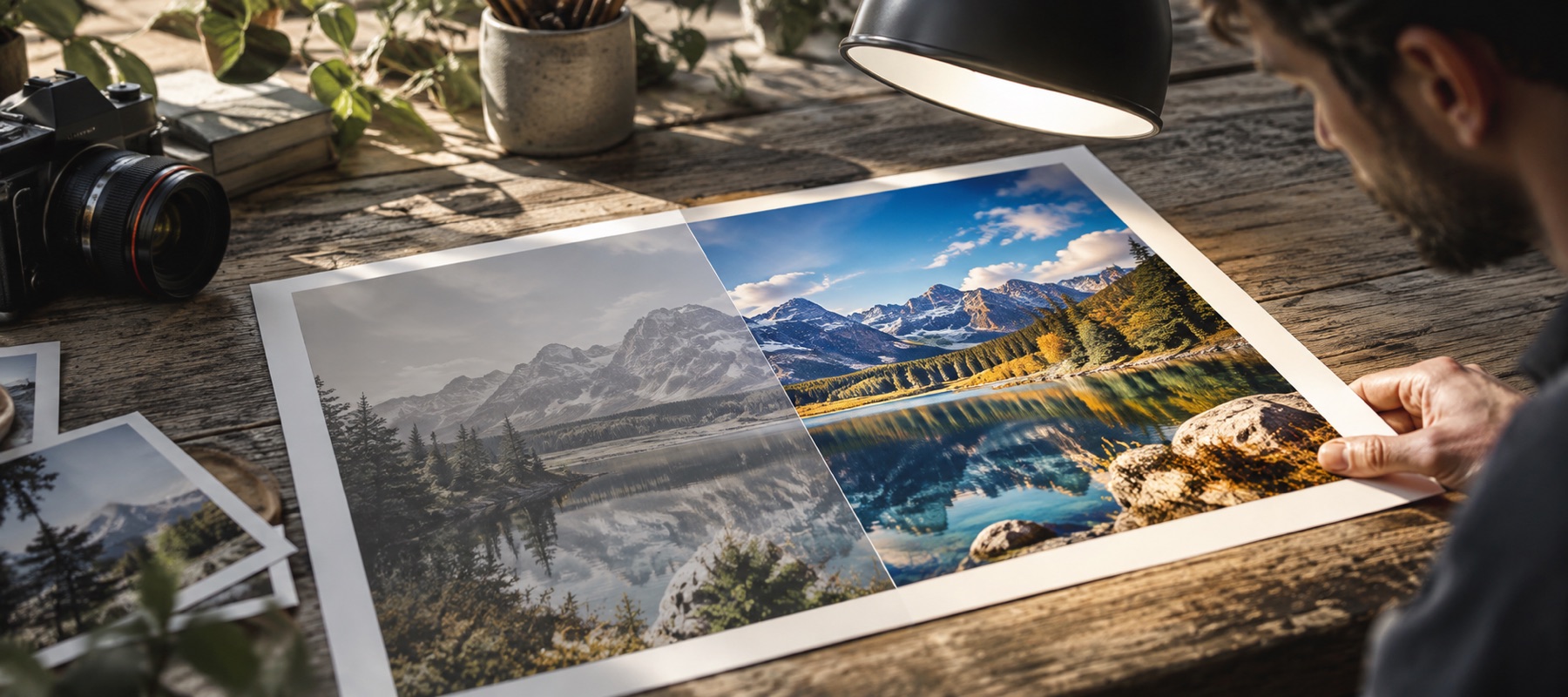


Photographic visual for Noise And Why Dark Photos Show It
Noise And Why Dark Photos Show It

Noise, and why dark photos show it

Noise is not something a dark photo has more of. It is something a dark photo has less signal to hide — and the moment you brighten it, the grain that was always there is brightened too.

Where it comes from

Light arrives as individual photons, and a sensor pixel counts them. Counting is noisy by nature: a pixel expecting a hundred photons gets ninety-one, then a hundred and eight. In bright light the count is large and the variation is small beside it. In a dim room the count is small and the variation is a large share of it. Add the sensor's own electronic noise, and a phone in a dark room records a picture where a sizeable part of every pixel's value is chance.

That chance shows up two ways: as fine, sandy grain in brightness, and as blotchy red and green specks in colour. The second is usually worse on phones, because the colour of each pixel is worked out from its neighbours.

Why brightening reveals it

Brightening a picture multiplies its values, and the grain is multiplied with them. The shadows, which held the fewest photons, are lifted most and show the most grain. This is why a low-light correction that only brightens can make a photo look worse, and why this site's low-light pages hold contrast back and measure the grain as they go.

How the grain reading is used here
Grain σMeansWhat the site does
under 2invisible at normal sizenothing
2–6visible at 100 % in shadowsNoise-safe switches on
above 6plain at normal sizedenoise is suggested

What a denoiser trades

A denoiser has to decide which small variations are grain and which are texture, and it cannot always tell. Smoothing hard removes the grain and the finest texture with it — skin turns waxy, foliage turns to paint. The classical denoiser on this site is steered by the measured σ, removes colour noise first (it can be removed hard at almost no cost), and has a Keep fine detail switch that leaves anything more than three times the noise untouched.

Getting less noise in the first place

Light is the cure; denoising is the treatment. Turn on a lamp, move toward a window, keep the phone still, and let it take a longer exposure rather than raising its gain. A clean, dim photo can be brightened; a noisy, bright one cannot be cleaned without cost.

  • No denoiser removes noise without removing some detail; the loupe at 1:1 is where to judge the trade.
  • Denoise runs before the tone curve here, so the lift does not amplify what it then removes.

Take it back to the picture

Corrected on your own machine — we never get a copy.